How many Champions League titles have Real Madrid won?
Real Madrid have won Europe's premier club competition 15 times, more than twice as many as second-placed Milan. That standard all-time total combines six European Cups won before the 1992/93 relaunch and nine titles in the Champions League era. Madrid have reached 18 finals overall and, remarkably, won all nine finals they have played since the competition adopted the Champions League identity.
| No. | Season | Final opponent | Result |
|---|---|---|---|
| 1 | 1955/56 | Reims | 4-3 |
| 2 | 1956/57 | Fiorentina | 2-0 |
| 3 | 1957/58 | Milan | 3-2 after extra time |
| 4 | 1958/59 | Reims | 2-0 |
| 5 | 1959/60 | Eintracht Frankfurt | 7-3 |
| 6 | 1965/66 | Partizan | 2-1 |
| 7 | 1997/98 | Juventus | 1-0 |
| 8 | 1999/00 | Valencia | 3-0 |
| 9 | 2001/02 | Bayer Leverkusen | 2-1 |
| 10 | 2013/14 | Atlético de Madrid | 4-1 after extra time |
| 11 | 2015/16 | Atlético de Madrid | 1-1; Madrid won 5-3 on penalties |
| 12 | 2016/17 | Juventus | 4-1 |
| 13 | 2017/18 | Liverpool | 3-1 |
| 14 | 2021/22 | Liverpool | 1-0 |
| 15 | 2023/24 | Borussia Dortmund | 2-0 |
The list is not one uninterrupted dynasty. Five trophies arrived in the competition's first five seasons, the sixth came in 1966, and then Madrid waited 32 years for number seven. Since 1998, three separate generations have added nine more: Raúl and Zinédine Zidane around the turn of the century, the Cristiano Ronaldo-led run from 2014 to 2018, and the adaptable Carlo Ancelotti sides of 2022 and 2024.
The three defeats complete the record. Benfica beat Madrid 5-3 in 1962, Inter won 3-1 in 1964, and Liverpool prevailed 1-0 in 1981. Madrid have therefore not lost a European Cup or Champions League final since Alan Kennedy scored in Paris in 1981. That unbeaten modern-final sequence is real, but it should not be confused with invincibility across the competition: Madrid have suffered many eliminations before the final, including long fallow stretches when reaching the last match was itself the missing step.
Final conversion is only one measure of European strength. The 15 titles came through different field sizes, entry rules and knockout structures. What persists is the club's capacity to rebuild around new leaders while treating the tournament as the highest internal benchmark. A list of medals shows the outcome; the eras below explain how Madrid repeatedly found a route back after the original side had disappeared.
That separation matters when supporters discuss “Madrid's Champions Leagues.” Alfredo Di Stéfano did not play the same tournament format as Luka Modrić, yet both belong to the same European championship lineage. For the current squad and schedule, use the Real Madrid team page. For completed scores across the tournament rather than only finals, see Champions League results.
How did Real Madrid win the first six European Cups?
Madrid did not merely join the new European Champion Clubs' Cup; they defined its opening image. The first five editions all ended with captain Miguel Muñoz or his successors lifting the trophy in white, creating a standard of European success before any rival had won it once.
The five-in-a-row side, 1956–60
The inaugural final showed the team's competitive personality. Reims led 2-0 inside ten minutes in Paris and later went 3-2 ahead, but Alfredo Di Stéfano, Héctor Rial and Marquitos drove Madrid to a 4-3 comeback. The next four finals were less uniform: Fiorentina resisted until late in 1957, Milan twice led before losing after extra time in 1958, Reims were beaten again in 1959, and Eintracht Frankfurt were overwhelmed in 1960.
Di Stéfano was the organising force as much as a scorer. He dropped away from the front line to connect midfield and attack, then arrived in the box; he scored in all five finals. Francisco Gento stretched teams on the left, Raymond Kopa added craft between lines, and Ferenc Puskás supplied devastating finishing after joining. Madrid could crowd central areas without losing width, a basic attacking problem opponents struggled to solve.
The Glasgow final became the clearest expression of that superiority. Eintracht scored first, but Madrid won 7-3 before a crowd of more than 127,000 at Hampden Park. Puskás scored four and Di Stéfano three. It remains a scoreline that sounds impossible for a modern final, yet it was no isolated accident: Madrid scored 112 goals across those five European campaigns and won all 17 home games.
Context matters. The field was smaller, only champions generally entered, and tactical/fitness preparation differed from the modern competition. Those differences make direct comparisons difficult, but they do not make five consecutive titles routine. Ajax and Bayern later won three straight; no club has matched Madrid's five.
The 1966 bridge
The original run ended when Barcelona eliminated Madrid in 1960/61. Madrid then lost the finals of 1962 and 1964, proving that merely reaching the decider did not preserve the dynasty. By 1966 the side had changed. Di Stéfano and Puskás were gone, Miguel Muñoz was now the coach, and a more Spanish core carried the “Yé-yé” generation.
Partizan led the Brussels final through Velibor Vasović, but Amancio equalised in the 70th minute and Fernando Serena struck the winner six minutes later. Gento was the crucial historical bridge: the winger had appeared in the first triumph and now collected a sixth winner's medal. Number six therefore represented renewal, not the last automatic instalment of the 1950s team.
The complete sequence can be compared with other clubs in our Champions League winners list by year. Madrid's early lead matters because every later generation inherited a club where Europe was already part of the institutional standard.
Why did La Séptima end a 32-year wait?
For supporters who grew up after 1966, Madrid's European supremacy was inherited history rather than lived experience. The club reached the 1981 final but lost 1-0 to Liverpool, and strong domestic generations repeatedly fell short. By 1998, the hunt for La Séptima—the seventh—had become a burden attached to every European campaign.
Juventus entered the Amsterdam final as favourites. They had retained Serie A and were appearing in a third consecutive Champions League final, while Madrid had finished fourth in Spain. Jupp Heynckes set his side up to stay compact and deny space to Alessandro Del Piero and Filippo Inzaghi. The decisive moment came after Roberto Carlos's attempt was blocked: Predrag Mijatović reacted quickest, moved around Angelo Peruzzi and squeezed in the 66th-minute winner from a tight angle.
The 1-0 score can look modest next to Madrid's early finals, but emotionally it may be the hinge of the entire 15-title story. Once the 32-year wait ended, Europe stopped feeling like a museum exhibit. Players such as Fernando Hierro, Manolo Sanchís, Clarence Seedorf, Roberto Carlos and the young Raúl had created their own reference point.
Two years later, Madrid's eighth title was more authoritative. The 2000 final against Valencia was the first European Cup/Champions League decider between clubs from the same country. Fernando Morientes headed the opener, Steve McManaman struck a controlled volley from the edge of the area, and Raúl finished a 60-metre break by rounding Santiago Cañizares. The 3-0 score reflected Madrid's control of Valencia's supply lines and their ability to attack through several routes.
The ninth in 2002 added glamour without becoming a simple exhibition. Raúl put Madrid ahead against Bayer Leverkusen, Lúcio quickly equalised, and Zinédine Zidane met Roberto Carlos's dropping cross with a left-foot volley on the stroke of half-time. The technique made it one of the final's defining goals, but the ending belonged to 21-year-old Iker Casillas. Introduced after César Sánchez was injured, he made crucial late saves as Leverkusen pressed.
Those three wins in five seasons were connected but not identical. The 1998 side survived as an underdog, the 2000 team outplayed a familiar domestic opponent, and the 2002 squad combined star quality with emergency defending. Raúl featured in all three and scored in two finals; Casillas's cameo pointed toward the next decade. This is why the period should be understood as a regenerated European culture, not only a list of famous names.
The club's current competition status belongs on the Real Madrid Champions League page. Historical context explains the weight of the shirt, but it cannot decide the next match.
How did Madrid turn La Décima into a three-peat?
The wait for title ten lasted 12 years and dominated the club's language. Madrid reached eight consecutive semi-finals or better from 2011 onward, but the breakthrough required one of the competition's most famous late goals. What followed was not immediate annual dominance; it was four titles in five seasons built under two coaches and decided through very different match states.
La Décima and the Atlético rematch
Atlético de Madrid were seconds from winning the 2014 final in Lisbon. Diego Godín's first-half header had rewarded their compact defending, and Madrid were running out of clean attacking ideas. In the third minute of added time, Sergio Ramos met Luka Modrić's corner and headed beyond Thibaut Courtois. Atlético's energy finally broke in extra time: Gareth Bale, Marcelo and Cristiano Ronaldo turned 1-1 into 4-1.
The score exaggerates the margin between the sides but captures Madrid's response once the emotional barrier fell. Carlo Ancelotti had balanced a high-powered front line with Modrić and Ángel Di María's carrying, while Ramos supplied the defining intervention. Ronaldo's late penalty was his 17th goal of the campaign, a competition record at the time, yet the title was not simply a top-scorer story.
Atlético forced a different final in 2016. Ramos scored early, Yannick Carrasco equalised, and neither side found a winner in extra time. Madrid converted all five penalties; Juanfran struck the post before Ronaldo took the decisive kick. Zidane, appointed in January, had not yet shaped the team over a full season, but he simplified roles, trusted the Casemiro-Modrić-Toni Kroos midfield and maintained calm through a tight match.
Zidane, Ronaldo and the three-peat
The 2017 side delivered the run's strongest final performance. Juventus had conceded only three goals in the tournament before Cardiff and equalised Ronaldo's opener through Mario Mandžukić. Madrid then controlled the second half. Casemiro's deflected strike restored the lead, Ronaldo attacked the near-post space for his second, and Marco Asensio completed a 4-1 win. Madrid became the first club to defend the title in the Champions League era.
Ronaldo's knockout production was extraordinary: ten goals from the 2017 quarter-finals onward, including five across the Bayern tie, a semi-final hat-trick against Atlético and two in the final. But Madrid's structure enabled that finishing. Casemiro protected transitions, Modrić escaped pressure, Kroos set rhythm, and full-backs Dani Carvajal and Marcelo supplied width. Benzema's movement created lanes even when he was not scoring.
The 2018 defence was less smooth. Madrid survived Juventus's second-leg comeback through Ronaldo's added-time penalty, then edged Bayern 4-3 on aggregate. Against Liverpool in Kyiv, Karim Benzema punished a goalkeeper's throw, Sadio Mané equalised, and Bale scored twice from the bench—the first an overhead kick. The 3-1 victory completed a three-peat no other Champions League-era team had achieved.
So how many Champions Leagues did Ronaldo win with Madrid? Four: 2014, 2016, 2017 and 2018. His goals were central, but the dynasty also depended on a stable elite midfield, defenders who contributed in decisive moments, and Zidane's management of roles and pressure. Browse the Champions League results archive to trace each route beyond the final.
What made the 2022 and 2024 titles different?
The four-year gap after Kyiv brought major change. Ronaldo, Ramos, Raphaël Varane, Keylor Navas and eventually Bale had left, while Vinícius Júnior, Rodrygo, Federico Valverde and Éder Militão took larger roles. Ancelotti returned in 2021 and did not attempt to recreate the three-peat side. He built around the remaining Kroos-Casemiro-Modrić midfield while giving the younger attackers room to decide transitions.
The 2022 campaign was a sequence of near-eliminations. Paris led the round-of-16 tie until Benzema's second-leg hat-trick changed the stadium and the press. Chelsea then recovered from a 3-1 first-leg defeat and moved ahead on aggregate at the Bernabéu, only for Modrić's outside-of-the-foot pass to release Rodrygo before Benzema headed the extra-time winner. Against Manchester City, Madrid trailed by two aggregate goals as the 90th minute approached; Rodrygo scored twice in roughly a minute and Benzema converted the extra-time penalty.
Calling those comebacks “magic” captures the emotion but hides the football. Ancelotti's substitutes increased running power, Madrid pressed more aggressively late in games, and Benzema combined elite movement with 15 tournament goals. The crowd amplified momentum, but players still had to recognise when opponents became protective and attack the penalty area immediately.
The final required the opposite skill: suffering without chasing the game. Liverpool generated pressure and shots, but Courtois repeatedly protected his area. Valverde's driven ball across goal found Vinícius at the far post for the only goal. Madrid's fourteenth was therefore won through explosive comeback phases in the knockouts and disciplined low-possession defending in Paris.
The 2023/24 team was more stable across the whole campaign. Madrid finished unbeaten over 13 matches, winning nine and drawing four. Jude Bellingham added carrying and box presence, Antonio Rüdiger became a defensive reference, and Vinícius/Rodrygo could threaten from flexible starting positions. They still needed penalties to eliminate holders Manchester City and two late Joselu goals to turn the semi-final against Bayern, but the route did not contain the repeated aggregate collapses of 2022.
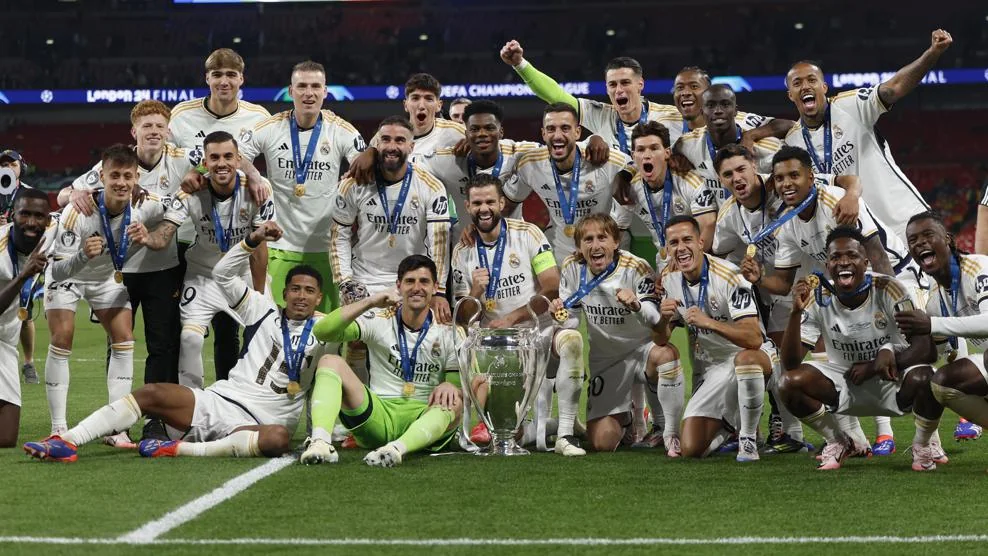
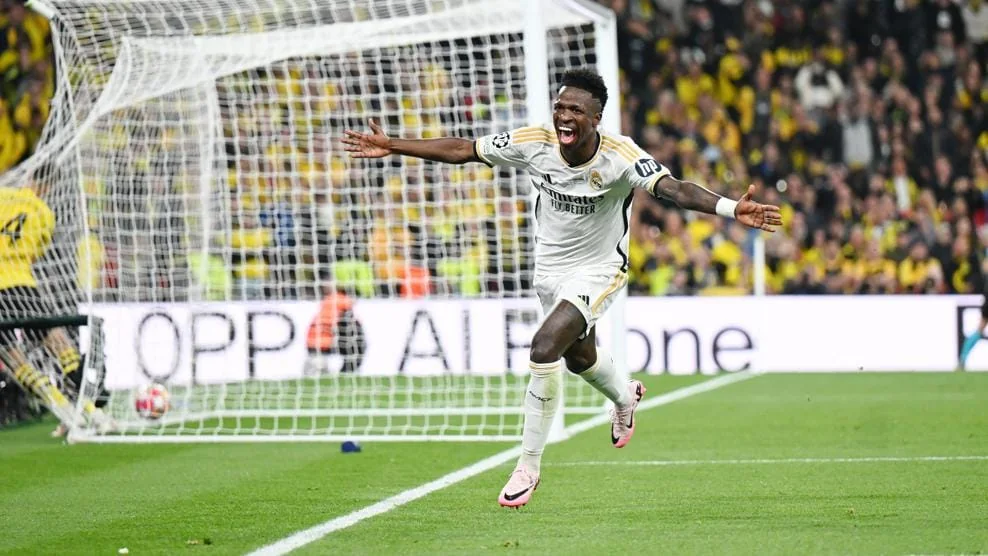
Dortmund tested that stability at Wembley. Karim Adeyemi ran into space behind Madrid's line, Niclas Füllkrug struck the post, and Courtois was busy before half-time. Madrid adjusted their spacing, Kroos found more time, and Dortmund's missed chances became costly. Carvajal headed Kroos's corner in the 74th minute; Vinícius added the second nine minutes later. It was controlled problem-solving rather than a stoppage-time rescue.
The 2024 medal also changed the internal record book. Carvajal and Modrić reached six final wins, while captain Nacho belonged to six victorious squads and Kroos closed his club career with a fifth final victory. The old core did not merely hand over to the next generation: it overlapped with it.
Real Madrid's last Champions League title remains 2023/24 as of 22 August 2026; Paris won the next two editions. History makes Madrid a permanent reference, not the automatic winner of the next draw. Check Madrid's current team page, the fixture list and today's matches for the live competition picture.
Sign in with Google to join the discussion.