How many Champions League titles have Barcelona won?
Barcelona have won the European Cup/UEFA Champions League five times: in 1992, 2006, 2009, 2011 and 2015. They have played eight finals in all, winning five and losing three. The shortest answer for a supporter is therefore five trophies, eight final appearances and 2015 as the most recent victory.
| Season | Final opponent | Barcelona's result | Outcome |
|---|---|---|---|
| 1960/61 | Benfica | 2-3 | Runners-up |
| 1985/86 | Steaua București | 0-0 after extra time; lost 0-2 on penalties | Runners-up |
| 1991/92 | Sampdoria | 1-0 after extra time | Winners |
| 1993/94 | Milan | 0-4 | Runners-up |
| 2005/06 | Arsenal | 2-1 | Winners |
| 2008/09 | Manchester United | 2-0 | Winners |
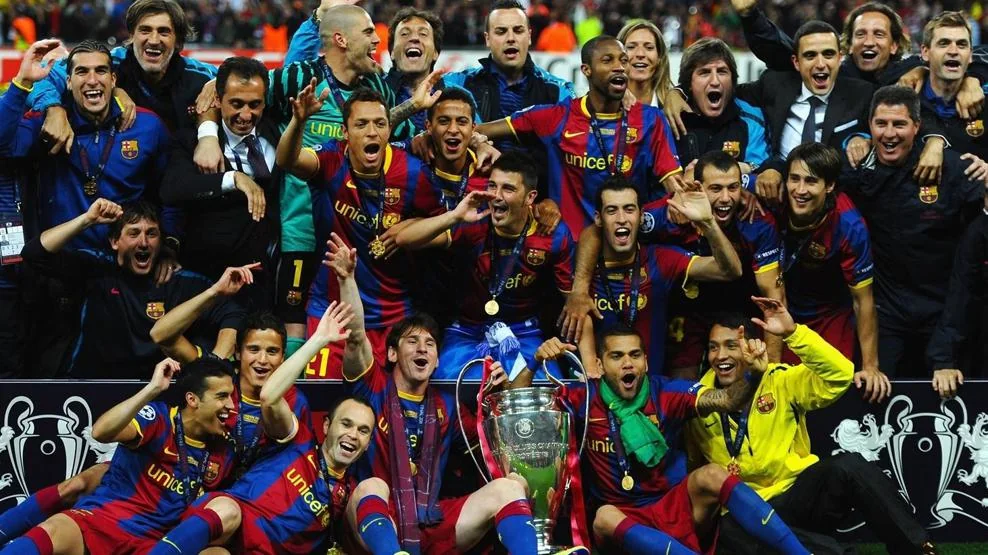
| 2010/11 | Manchester United | 3-1 | Winners |
| 2014/15 | Juventus | 3-1 | Winners |
The complete final list shows why the number alone misses part of the story. Barcelona first reached the decider in 1961 but lost to Benfica, then endured an agonising penalty-shootout defeat against Steaua București in 1986. Johan Cruyff's team finally broke through against Sampdoria at Wembley in 1992. The heavily fancied holders then lost 4-0 to Milan in 1994 before four wins in four finals created the modern trophy collection.
Does the 1992 European Cup count as a Champions League title?
Yes. UEFA records the European Champion Clubs' Cup and UEFA Champions League as one continuous competition, so Barcelona's 1992 European Cup is included in their official five-title total. The Champions League name began with the 1992/93 season. If a comparison is limited strictly to that branded era, Barcelona have four titles—2006, 2009, 2011 and 2015—from five finals. Their only Champions League-era final defeat was against Milan in 1994.
The distinction is useful when comparing eras, but it should not erase the Wembley breakthrough. The 1992 side became champions of Europe in the direct predecessor of today's tournament, and its trophy sits in the same historical line as the four that followed. Fans checking a “Barcelona Champions League wins” list should expect to see all five.
Barcelona have not lifted the trophy since beating Juventus in Berlin on June 6, 2015. That date matters because older summaries sometimes present 2015 as one success in an ongoing run; from the viewpoint of August 2026, it remains the end point of their winning list. For current matches, use the Barcelona team page. For scores across the competition, see Champions League results.
How did Barcelona win their first European Cup in 1992?
Barcelona's first European crown arrived the hard way. They had lost their previous finals to Benfica in 1961 and Steaua București on penalties in 1986, then nearly fell in the second round of the 1991/92 tournament. Kaiserslautern overturned a 2-0 first-leg deficit in Germany before José Mari Bakero's late away goal rescued Johan Cruyff's team. That escape mattered: the eventual champions were talented, but their path was never as smooth as the “Dream Team” nickname can make it sound.
The competition used an unusual format that season. After two knockout rounds, eight survivors entered two four-team mini-leagues, with only the two group winners progressing to the final. Barcelona finished above Sparta Prague, Benfica and Dynamo Kyiv. Sampdoria came through the other section, bringing Roberto Mancini, Gianluca Vialli and a defence protected by goalkeeper Gianluca Pagliuca to Wembley.
The final on May 20, 1992 was poised at 0-0 after 90 minutes. Hristo Stoichkov had struck a post and both teams had opportunities, but neither could turn its best football into a goal. In the 112th minute, Barcelona won a free-kick just outside the penalty area. José Mari Bakero nudged the ball to Ronald Koeman, whose powerful right-footed shot drove through the defensive wall and beyond Pagliuca. Barcelona held on for a 1-0 extra-time win.
1992 final at a glance
- Venue: Wembley Stadium, London
- Opponent: Sampdoria
- Score: Barcelona 1-0 Sampdoria after extra time
- Decisive moment: Ronald Koeman free-kick, 112th minute
- Coach: Johan Cruyff
Why did Cruyff's Dream Team matter beyond one final?
Cruyff's side gave Barcelona a repeatable football idea, not merely a famous team sheet. Young holding midfielder Josep Guardiola offered a passing reference in front of the defence. Koeman could step forward and break lines from the back, while Michael Laudrup and Stoichkov supplied invention and penetration higher up. Albert Ferrer and other locally rooted players helped connect the team to a club identity rather than turning it into a collection of imported stars.
Yet the Wembley match is also a warning against reducing that identity to pretty passing. Sampdoria forced Barcelona to solve a tight, physically demanding final in extra time, and the breakthrough came from a rehearsed dead-ball situation. The side's greatest achievement that night was remaining committed without becoming careless. Cruyff's principles gave them a way to control territory; patience and Koeman's technique converted control into the trophy.
The win became a reference point for later Barcelona teams because it proved that an ambitious style could survive Europe's most pressured match. It did not single-handedly create the 2009 or 2011 sides, and their structures were not identical, but Guardiola had experienced the breakthrough from the pitch before later reshaping many of its ideas as coach. For fans exploring the wider lineage, the Champions League winners list by year places the 1992 triumph alongside every modern champion.
Why was the 2006 Champions League title a turning point?
The 2006 trophy changed Barcelona's European scale. Fourteen years had passed since Wembley, and for a club of Barça's reach, one European Cup still felt strangely modest. Frank Rijkaard's side did more than end that wait: it connected Cruyff's original breakthrough to the academy-led team that would dominate under Pep Guardiola. The bridge was built around players such as Víctor Valdés, Carles Puyol, Xavi, Andrés Iniesta and the emerging Lionel Messi, with Ronaldinho, Samuel Eto'o and Deco providing a world-class peak in the present.
Barcelona reached Paris with substance behind the glamour. They won five and drew one of their six group games, scoring 16 times while conceding only twice. Chelsea, Benfica and Milan then fell in the knockout rounds. Ronaldinho was the tournament's defining entertainer and scored seven goals; Eto'o supplied six. Messi contributed before injury ruled him out of the final, an important detail because the 2006 success belongs primarily to Rijkaard's mature team rather than to the later Messi-centred version.
The final against Arsenal on May 17 initially seemed to swing Barcelona's way when goalkeeper Jens Lehmann brought down Eto'o and became the first player sent off in a European Cup final. Yet ten-man Arsenal defended stubbornly and took a 37th-minute lead through Sol Campbell. Barcelona had more possession and an extra player, but with the match entering its final quarter, the favourites were still behind.
| Minute | Moment | Why it mattered |
|---|---|---|
| 18' | Lehmann sent off for fouling Eto'o | Arsenal had to protect a large space with ten players. |
| 37' | Campbell heads Arsenal in front | Barcelona faced a disciplined low block and scoreboard pressure. |
| 61' | Henrik Larsson replaces Mark van Bommel | A second forward gave Barcelona sharper combinations near the box. |
| 76' | Eto'o equalises from Larsson's touch | Barcelona finally broke Arsenal's resistance. |
| 81' | Belletti scores from another Larsson assist | The substitute right-back completed the 2-1 comeback. |
Rijkaard's changes made the difference. Iniesta had entered at half-time, Larsson came on after an hour and Juliano Belletti replaced Oleguer at right-back. Larsson's deft first touch released Eto'o for the equaliser, then the Swede combined with Belletti for the winner five minutes later. Ronaldinho's status had carried much of the campaign, but the decisive sequence was a lesson in squad depth: three substitutes helped turn a losing final.
How did Paris prepare Barcelona for the Guardiola era?
The trophy restored the belief that Barcelona could turn a clear football identity into European wins rather than admiration alone. Puyol and Valdés started the final; Iniesta changed it from the bench; Xavi was returning from a major knee injury; Messi had already shown his potential during the run. Those players did not simply inherit a winning shirt in 2008/09—they had lived through the standards, pressure and recovery required to finish the job.
That does not mean 2009 was an automatic sequel. Rijkaard's cycle later declined, Guardiola altered the pressing, spacing and personnel, and several major roles changed. The meaningful continuity was cultural: academy technique could coexist with elite recruitment, and stars could be supported by specialists willing to decide a match from the bench. For Barcelona's current European context, the Barcelona Champions League team page keeps fixtures and results separate from this historical account.
What made Guardiola's 2009 and 2011 winners special?
Pep Guardiola's Barcelona did not dominate only by keeping the ball. Possession worked because the players created short passing angles, spread opponents across the pitch and attacked immediately when a gap appeared. When the ball was lost, the nearest players pressed before the opposition could escape. Sergio Busquets protected the centre, Xavi set the rhythm, Andrés Iniesta carried and combined between lines, and Lionel Messi moved away from a fixed striker's position to make defenders choose between following him or leaving him free.
| Final | Score | Barcelona scorers | Defining feature |
|---|---|---|---|
| 2009, Rome | 2-0 vs Manchester United | Eto'o 10', Messi 70' | Adaptability after an early United surge and a reshuffled defence |
| 2011, Wembley | 3-1 vs Manchester United | Pedro 27', Messi 54', Villa 69' | Sustained territorial control and fluid front-three movement |
How did Barcelona win the 2009 final in Rome?
Manchester United started the 2009 final aggressively, and Cristiano Ronaldo tested Barcelona before the Catalans had settled. Then Eto'o received Iniesta's pass, shifted past Nemanja Vidić and beat Edwin van der Sar at the near post in the 10th minute. The goal transformed the rhythm. United could no longer wait for Barcelona to overcommit, while Xavi and Iniesta gained the time to move the holders from side to side.
The performance also required improvisation. Dani Alves and Éric Abidal were suspended, so captain Carles Puyol moved to right-back, Yaya Touré played in central defence and Sylvinho started on the left. That was not Guardiola's ideal back four, yet Barcelona protected it by controlling the ball and closing central spaces. Xavi hit the post after half-time, then delivered the 70th-minute cross that Messi, despite being one of the smallest players in the area, headed over Van der Sar.
The 2-0 win completed Barcelona's Liga, Copa del Rey and Champions League treble—the first by a Spanish men's club. It also made Guardiola a European champion as coach in his first season managing a senior side, 17 years after he had played in Barcelona's first winning final. The achievement was both tactical and emotional: a team rebuilt around home-developed players had reached the summit immediately.
Why was the 2011 Wembley performance even clearer?
By 2011, Guardiola's model was more settled. Pedro and David Villa began wide, forcing United's defence to cover the full width, while Messi drifted into midfield and created a numerical problem around Michael Carrick and Ryan Giggs. Xavi stepped forward to release Pedro for the 27th-minute opener. Wayne Rooney equalised seven minutes later, but it was United's only shot on target; the score was level without the match feeling balanced.
Messi restored the lead from outside the box in the 54th minute, punishing the space created when United hesitated between pressing and retreating. Villa curled the third into the top corner after Busquets recovered a loose ball near the penalty area. Those goals were spectacular, but the repeatable advantage came earlier: Barcelona kept recovering possession close to where they lost it, so United's forwards were asked to defend and had little opportunity to build counterattacks.
Calling either team “perfect” would hide the practical decisions that made it work. The 2009 side solved suspensions and an unsettled opening; the 2011 side refined the positioning and pressing until an elite opponent could barely leave its own half. Together, the finals explain why this era is remembered for more than two additions to a trophy list. Readers following the current competition can switch from history to the Champions League fixtures page without confusing Guardiola's era with today's squad.
How did Barcelona complete the 2015 treble, and when did they last win?
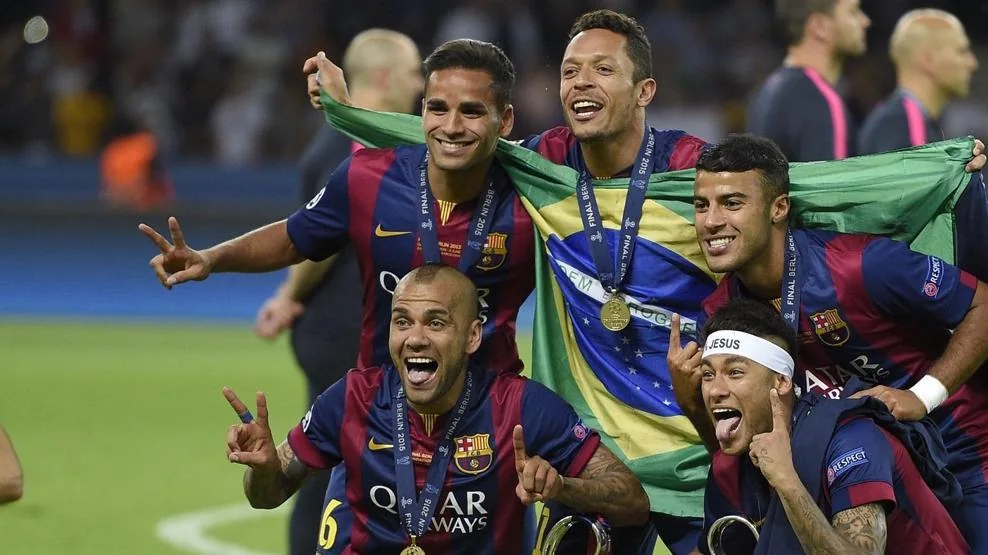
Barcelona's fifth and latest Champions League title came on June 6, 2015, when Luis Enrique's team beat Juventus 3-1 at Berlin's Olympiastadion. It completed the club's second treble after Barcelona had already secured La Liga and the Copa del Rey. The final score looks comfortable, but the contest was alive deep into the second half: Juventus equalised, carried genuine momentum and forced Barcelona to show a more direct side than Guardiola's teams usually needed.
Ivan Rakitić opened the scoring in the fourth minute at the end of a sweeping move that travelled from Lionel Messi's crossfield pass through Jordi Alba, Neymar and Andrés Iniesta. Barcelona threatened to pull away, but Gianluigi Buffon kept Juventus close. Ten minutes after half-time, Álvaro Morata reacted first when Marc-André ter Stegen parried Carlos Tévez's shot and made it 1-1.
The response captured the 2014/15 side's difference. Barcelona could circulate patiently through Sergio Busquets, Rakitić and Iniesta, yet they could also reach goal before an opponent reorganised. In the 68th minute, Messi drove infield and forced another Buffon save; Luis Suárez attacked the rebound to restore the lead. With Juventus committing players forward in stoppage time, substitute Pedro released Neymar to finish the final counterattack.
What made Messi, Suárez and Neymar so difficult to defend?
The “MSN” trio could create without relying on one fixed pattern. Messi drifted inside to pass or shoot, Suárez occupied centre-backs and attacked the six-yard box, and Neymar could isolate a full-back or sprint beyond the line. They scored 27 of Barcelona's 31 Champions League goals that season—about 87%. Messi and Neymar finished with ten each, while Suárez scored seven, including the decisive final goal.
Those numbers should not obscure the structure behind them. Busquets protected transitions, Rakitić covered ground around Messi's movements, Iniesta connected midfield to attack, and Dani Alves plus Alba supplied width. Barcelona also eliminated Manchester City, Paris Saint-Germain and Bayern before meeting Juventus. The front three delivered the finishing, but the path demanded control against several different tactical styles.
When did Barcelona last win the Champions League?
Barcelona last won the Champions League in 2015, defeating Juventus in Berlin on June 6. As of August 22, 2026, that remains their fifth and most recent title. No later campaign has changed the official count. The gap now exceeds 11 years, which is why a current answer must not describe 2015 as merely the latest point in a recent dynasty.
There is no honest single-cause explanation for every season since. Coaches, squads, opponents and match situations have changed, while individual eliminations have followed very different patterns. A more useful conclusion is that the 2015 team joined an experienced control structure to a front three capable of solving games through combination play, counterattacks or individual actions. Replicating that balance is harder than simply signing famous attackers.
Barcelona's five wins in one line: Cruyff in 1992, Rijkaard in 2006, Guardiola in 2009 and 2011, and Luis Enrique in 2015.
To check the present rather than the historical record, use today's Champions League schedule, the current table and Barcelona's team hub.
Sign in with Google to join the discussion.