Who won the 2026 Champions League final?
Paris Saint-Germain won the 2026 UEFA Champions League, beating Arsenal 4–3 in a penalty shootout after the final finished 1–1 following extra time. The match was played at the Puskás Aréna in Budapest on Saturday, 30 May 2026.
| Champion | Paris Saint-Germain |
|---|---|
| Runner-up | Arsenal |
| Score after extra time | PSG 1–1 Arsenal |
| Penalty shootout | PSG won 4–3 |
| Goals | Kai Havertz 6'; Ousmane Dembélé 65' penalty |
| Venue | Puskás Aréna, Budapest, Hungary |
| Final player of the match | Vitinha |
The distinction between the two scores is important. Official match records show a 1–1 draw after 120 minutes because shootout kicks do not become match goals. The 4–3 figure decides the trophy. PSG converted four of five penalties, while Arsenal failed with two of theirs. Gabriel Magalhães sent the final Arsenal kick over the bar.
Arsenal had led from the sixth minute after Havertz punished a blocked PSG clearance. The holders dominated possession and eventually levelled when Dembélé converted a second-half penalty. Neither side scored in extra time, so PSG defended the title from the spot one year after winning the club's first European Cup.
This was not a repeat of PSG's emphatic 5–0 win over Inter in the 2025 final. Arsenal's compact defending made the 2026 match narrower, slower and more anxious. That contrast is part of the achievement: PSG retained the competition by solving a completely different final.
For the latest completed matches, use the Champions League results page. The Champions League table shows the league-phase context, but the final itself came down to the sequence below: an early Arsenal strike, sustained Paris pressure, one penalty in normal time and another set of penalties after 120 minutes.
How did Arsenal's early goal change the final?
Havertz's goal gave Arsenal the score they wanted before the match had settled. It also created the final's central tension: how long could a compact defensive plan survive when PSG were allowed to own the ball? For almost an hour, the answer looked like “long enough.”
Why was the sixth-minute goal so important?
Arsenal did not score from a slow positional attack. Their first line pressured PSG's build-up, Leandro Trossard charged down Marquinhos's attempted clearance and the ricochet released Havertz. The forward ran into the right channel and drove his finish high past Matvei Safonov from a tight angle. It was his second goal in a Champions League final after scoring Chelsea's 2021 winner.
The sequence rewarded Arsenal's willingness to engage PSG before dropping into shape. It also forced Luis Enrique's side to attack a set defence rather than invite Arsenal forward and use the spaces behind them. Paris could circulate possession through Vitinha and the back line, but progress into the penalty area was much harder.
Did Arsenal sit too deep?
The easy verdict after a defeat is that Arsenal retreated too much. The match evidence is more complicated. PSG held about three-quarters of the possession, while Arsenal completed only 69 passes in the first half. Yet Paris managed only one shot on target before the break. Gabriel Magalhães and William Saliba protected the centre, with Bukayo Saka and Trossard dropping to help the full-backs. PSG controlled two-thirds of the pitch but repeatedly met another Arsenal line at the edge of the box.
Arsenal also retained a counterattacking threat. Marquinhos had to make a last-ditch block to stop Havertz scoring again before half-time. That chance is the strongest defence of Mikel Arteta's approach: his side were not simply waiting for an inevitable equaliser. They had identified how PSG's man-oriented defence could be attacked when the first challenge was escaped.
The risk was cumulative. Every unsuccessful clearance returned possession to Paris, and every deep defensive action demanded concentration. Arsenal's narrow distances reduced PSG's clean chances, but they also left Havertz isolated and made it difficult to keep the ball after a regain. The longer that pattern continued, the more likely one mistimed challenge or one successful wide combination would change the final.
That is why the plan should be called effective but costly. It pushed the defending champions close to defeat and kept their celebrated attack frustrated. It did not create enough possession-based rest for Arsenal's defenders. Fans can follow both teams beyond the final on the Arsenal team page and Paris Saint-Germain team page; the tactical question will recur whenever either side faces an early lead in a knockout match.
Why was Dembélé's penalty the decisive tactical moment?
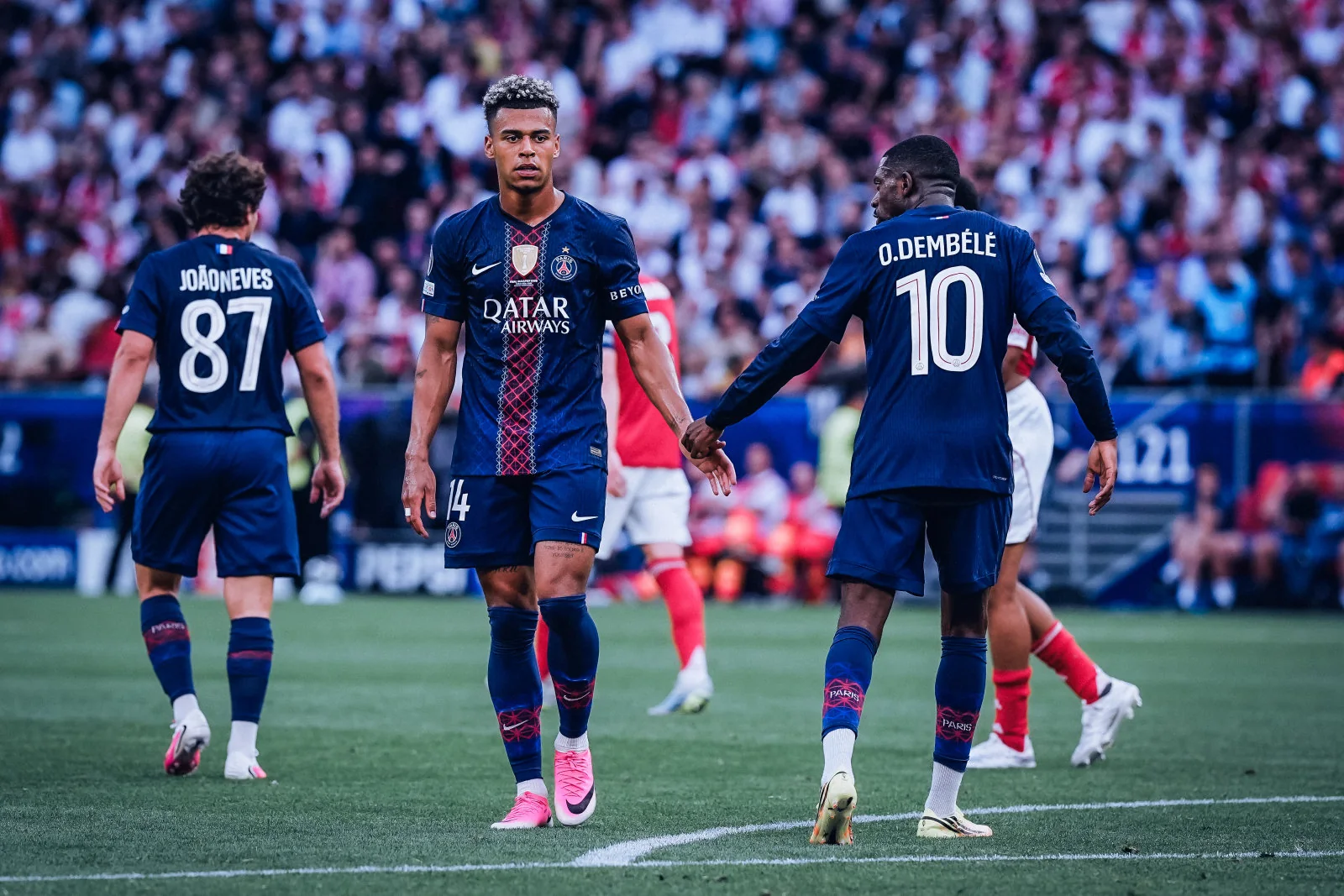
Ousmane Dembélé's equaliser mattered because the move that earned it was the first clear answer to Arsenal's defensive shape. PSG had circulated the ball for nearly an hour without consistently putting an attacker behind the back line. In the 62nd minute, Dembélé and Khvicha Kvaratskhelia changed the picture with a quick exchange on the left. Kvaratskhelia accelerated beyond Cristhian Mosquera, whose late challenge brought him down inside the area.
How did PSG finally open Arsenal's compact block?
The breakthrough came from movement rather than possession alone. After half-time, PSG rotated positions more often and gave Arsenal fewer fixed reference points. Dembélé did not remain between the centre-backs waiting for service. He moved toward the left side, connected with Kvaratskhelia and helped send his winger into the channel behind Mosquera. That one-two turned a static attack into a race toward goal.
The penalty itself was delayed for treatment and the normal match administration, but Dembélé showed no sign of the tension. In the 65th minute, he struck low to David Raya's left while the goalkeeper moved the other way. PSG were level at 1–1, and Arsenal could no longer devote every decision to defending Havertz's early lead.
That distinction makes the penalty the tactical hinge of the final. The foul was an individual mistake, yet PSG created the conditions for it by altering their movement. Mosquera had coped when the ball and his opponent were in front of him. Once Kvaratskhelia combined at speed and attacked the space behind, the defender had to turn and chase. For a fan rewatching the move, the revealing moment is not the collision; it is Dembélé's supporting angle for the pass before it.
Why did Vitinha matter even without scoring?
Vitinha's influence was quieter but constant. Arsenal's clearances rarely ended PSG attacks because the midfielder positioned himself to collect second balls and restart the pressure. His passing did not magically dismantle the block, but it forced Arsenal to repeat the same exhausting defensive movements. UEFA's technical observers named him player of the match, an award that reflects control across 120 minutes rather than one highlight.
PSG nearly converted that control into a winner. Kvaratskhelia's 77th-minute effort took a deflection and struck the post. In the 89th minute, Vitinha curled a shot onto the roof of the net, while substitute Bradley Barcola also found transition opportunities as Arsenal tired. None went in, and extra time remained goalless.
That last fact keeps the analysis honest: PSG solved enough of Arsenal's plan to equalise, not enough to win in open play. Dembélé's penalty preserved their title defence and shifted the contest toward the shootout, where composure would matter more than territory. The complete scoreline and other knockout outcomes remain available in the Champions League results hub.
How did PSG win the penalty shootout 4–3?
PSG won by converting four of five kicks while two Arsenal takers missed the target. Matvey Safonov did not make a shootout save, an important detail often lost in a one-line recap. David Raya actually produced the only save, denying Nuno Mendes. Paris survived because their remaining takers kept scoring and left Arsenal under pressure on the final kick.
What was the complete kick-by-kick sequence?
| Round | PSG kick | Arsenal kick | Running score |
|---|---|---|---|
| 1 | Gonçalo Ramos scored | Viktor Gyökeres scored | 1–1 |
| 2 | Désiré Doué scored | Eberechi Eze missed left | 2–1 PSG |
| 3 | Nuno Mendes saved by Raya | Declan Rice scored | 2–2 |
| 4 | Achraf Hakimi scored | Gabriel Martinelli scored | 3–3 |
| 5 | Beraldo scored | Gabriel Magalhães shot over | 4–3 PSG |
Ramos set the tone by driving the opening kick high to the right, and Gyökeres replied low to the right. Doué then converted before Eze's stuttering approach ended with his shot sliding outside the left post. That was the first advantage, but it disappeared when Raya pushed away Mendes's low attempt and Rice made it 2–2.
The fourth pair kept the tension level. Hakimi found the bottom-left corner, while Martinelli went high to the left. Beraldo, a substitute who had entered because of Vitinha's injury, then placed PSG's fifth kick into the bottom-right corner. Gabriel had to score to extend the contest. His left-footed effort cleared the crossbar, ending the final immediately.
Did Safonov save the shootout for PSG?
No—and saying so would diminish what actually decided it. Eze and Gabriel failed to hit the target, so Safonov was not credited with a save. PSG's edge came from four clean conversions and from repeatedly making Arsenal answer. Raya's intervention against Mendes was excellent, but it only restored parity; Arsenal still needed to match the final two Paris kicks.
There was another layer of difficulty for PSG. Dembélé, Kvaratskhelia, Vitinha and captain Marquinhos had all left the pitch before penalties. Luis Enrique could not simply hand the five kicks to his most famous starters. Ramos and Beraldo had come from the bench, yet both converted. Doué and Hakimi also accepted the responsibility, while Mendes recovered from his miss to celebrate rather than become the story of the night.
For Arsenal, the shootout was brutally different from losing because a goalkeeper guessed correctly. Two attempts missed the frame, meaning there was no rebound in confidence from forcing a save. For PSG, the lesson was equally clear: a shootout is a team sequence, not a duel decided solely by goalkeepers. See the final alongside every other completed tie in the Champions League results.
What does PSG's back-to-back title mean for Champions League history?
PSG's second title placed them in a two-club category for the modern competition. Since the European Cup was rebranded as the Champions League in 1992, only Real Madrid and PSG have successfully defended the trophy. Madrid won three consecutive editions from 2016 to 2018; Paris followed their 2025 breakthrough with the 2026 shootout win in Budapest.
How rare is retaining the Champions League?
The era matters. Real Madrid, Benfica, Inter, Ajax, Bayern Munich, Liverpool, Nottingham Forest and AC Milan all won consecutive European Cups before or around the transition to the Champions League. The expanded modern competition created more rounds, more elite opponents and far less room for a champion to repeat. PSG were the first holders even to return to the final since Madrid completed their three-peat in 2018.
Paris also retained the trophy in a completely different kind of final. Their first title came with a record 5–0 final victory over Inter in 2025. Twelve months later, Arsenal reduced them to one goal across 120 minutes and forced them into penalties. Winning both contests suggests a team capable of overwhelming an opponent and of surviving when its normal attacking rhythm is disrupted.
The wider campaign supports that reading. PSG scored 45 Champions League goals in 2025/26, matching the single-season competition record credited to Barcelona's 1999/2000 side. Yet their final was won by four shootout takers, two of whom began the match on the bench. That combination of attacking production and squad responsibility is more useful evidence of staying power than the vague label “dynasty.” A third consecutive title remains a challenge to be played, not a result that history has already granted them.
Luis Enrique now owns three Champions League titles as a coach: Barcelona in 2015 and PSG in 2025 and 2026. Only five coaches had reached at least three when Paris won in Budapest. He also became just the second coach in the Champions League era to retain the trophy, joining Zinedine Zidane. The achievement strengthens the case that PSG's transformation is a coaching project, not merely a collection of expensive players.
What does the defeat mean for Arsenal?
For Arsenal, the answer is painful but not empty. The club have reached two European Cup or Champions League finals and lost both: 2–1 to Barcelona in 2006 and on penalties to PSG in 2026. Havertz's early goal put them closer than the eventual shootout score can convey, but the first European crown remains missing.
The season should not be rewritten as failure. Arsenal ended a 22-year wait for the Premier League title and continued a clear European progression: quarter-finalists in 2023/24, semi-finalists in 2024/25 and finalists in 2025/26. That sequence does not guarantee a trophy, but it shows that returning to the final is now a credible sporting target rather than nostalgia for 2006.
The next campaign resets every assumption. PSG must navigate the burden of being twice-defending champions, while Arsenal must turn the memory of Budapest into better control when protecting a lead. Fans planning ahead can use the 2026/27 Champions League guide, monitor dates on the fixtures page and follow the evolving Champions League table. The 2026 final is settled history; what either club builds from it remains open.
Sign in with Google to join the discussion.