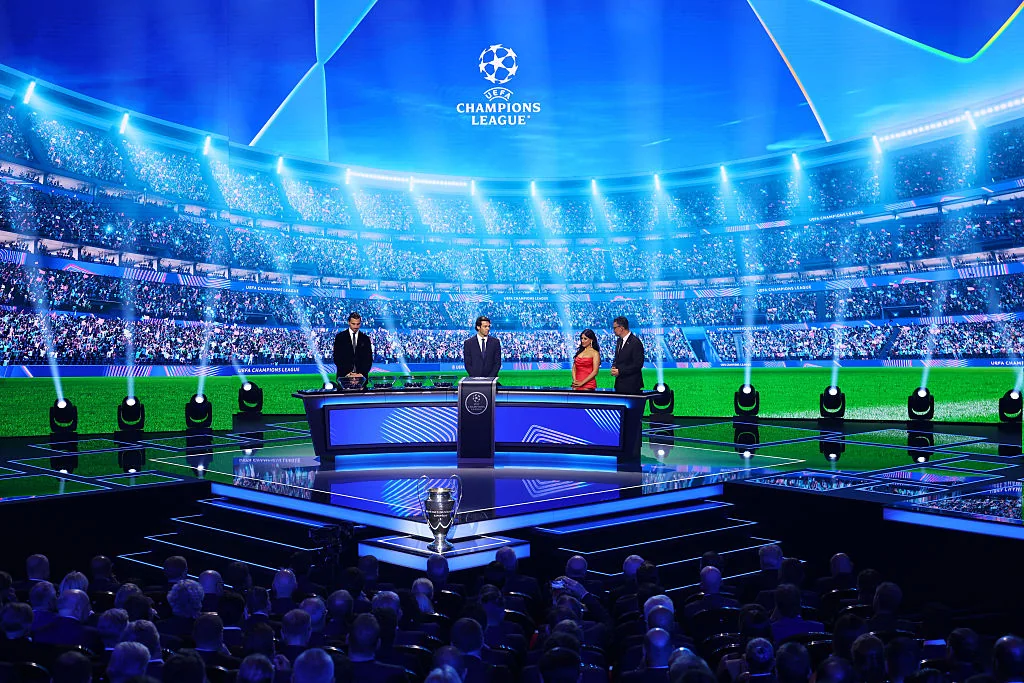
The Champions League draw is not one event. UEFA holds separate draws for qualifying, the 36-team league phase, the knockout phase play-offs and the round-of-16 bracket. Each ceremony answers a different supporter question: who is the next two-legged opponent, which eight clubs will a team face, or which side of the road to the final will it occupy?
What does the Champions League draw decide?
In qualifying, the draw creates knockout ties within the champions path or league path and normally identifies which club hosts the first leg. In the league phase, it gives every club eight different opponents—four at home and four away. After the single league table is complete, later draws place teams into restricted knockout pairings and eventually a fixed bracket. A ball drawn in August therefore does a very different job from a ball drawn after Matchday 8.
One competition, several different draws
- Qualifying draws: produce first-, second- and third-round ties plus the play-offs. Some occur before the previous round has finished, so a placeholder such as “winner of Tie A” may appear.
- League-phase draw: assigns two opponents from each of four pots, with one from each pot at home and one away.
- Knockout play-off draw: matches teams placed 9th–16th against teams placed 17th–24th within ranking-based pairs.
- Round-of-16 draw: places the top eight and play-off winners in the bracket; the route through the quarter-finals and semi-finals then follows that structure.
For 2026/27, UEFA scheduled the qualifying draws for 16 and 17 June, 20 July and 3 August. The league-phase draw is set for 27 August 2026 at 18:00 CET, one day after the last qualifying play-off second legs and before Matchday 1 begins on 8 September. On the research date, UEFA had not yet confirmed the 2026/27 knockout draw dates, so dates from the previous campaign should not be treated as this season's calendar.
What the draw does not decide immediately
The league-phase ceremony decides opponents and whether each matchup is home or away, but it does not necessarily publish the final matchday order and kick-off details at the same instant. UEFA must build a workable calendar across 36 clubs, shared stadiums, cities, broadcasters and the requirement that home and away sequences remain balanced. The complete fixture list follows after those checks.
That gap is why a supporter should not book travel from an opponent graphic alone. Wait until the matchup has an assigned date, venue and kick-off. The 2026/27 season guide provides the dated framework, while the fixtures page is the practical source once individual matches are scheduled.
How do the four league-phase pots work?
The 36 league-phase clubs are divided into four pots of nine. The reigning Champions League winner is the top seed in Pot 1; the remaining positions follow UEFA's individual club coefficient ranking at the beginning of the season. Coefficients reflect recent European performance, so pot placement is not simply the order of the latest domestic league table.
The crucial change from the old group stage is what happens next. Pots no longer keep teams apart for an entire mini-league. Every club is assigned two opponents from Pot 1, two from Pot 2, two from Pot 3 and two from Pot 4. The pots are best understood as four strength bands used to give each club a broadly comparable mix of opponents.
Why Pot 1 still faces Pot 1
A Pot 1 club must play two other Pot 1 clubs, just as a Pot 4 club does. Pot 1 status therefore does not buy a route free of Europe's strongest coefficient teams. Its benefit is more subtle: the club itself occupies one of the nine highest positions, while every participant receives the same two-from-each-pot structure. A supporter evaluating the draw should look at the actual eight names, not celebrate the pot label as if it guaranteed an easy group.
| Opponent pot | Home | Away | Total |
|---|---|---|---|
| Pot 1 | 1 opponent | 1 opponent | 2 |
| Pot 2 | 1 opponent | 1 opponent | 2 |
| Pot 3 | 1 opponent | 1 opponent | 2 |
| Pot 4 | 1 opponent | 1 opponent | 2 |
| Total | 4 | 4 | 8 |
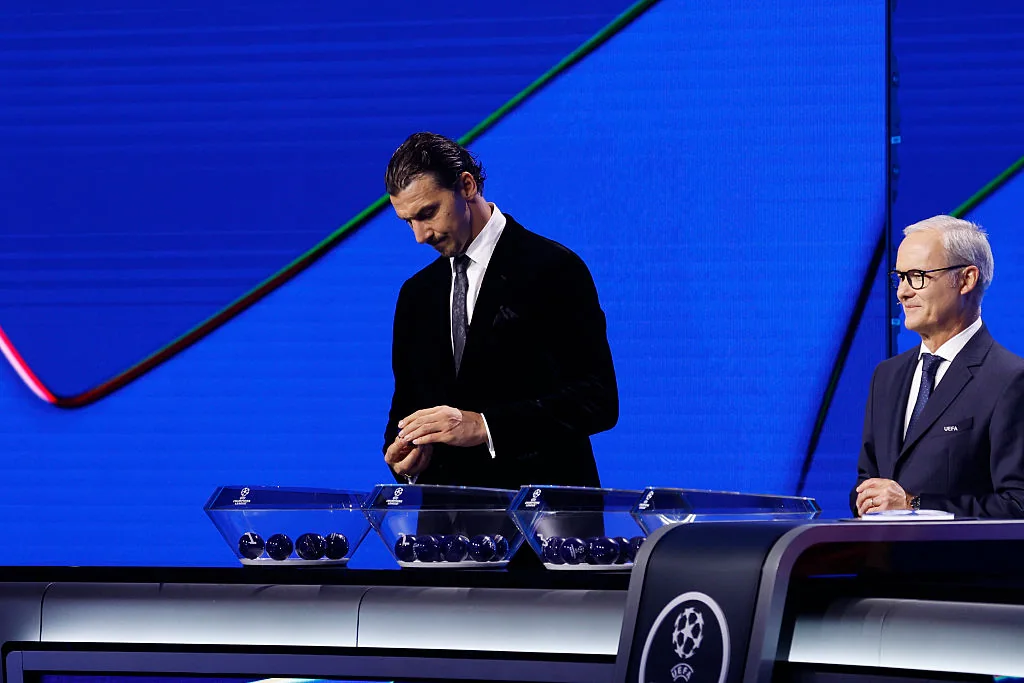
Eight opponents, four home and four away
For each pot, one opponent is assigned at home and the other away. The club therefore finishes with four home fixtures and four away fixtures against eight different teams. There is no return league-phase match against the same opponent. If Barcelona hosts one Pot 1 rival, for example, its other Pot 1 assignment must be away; the same balancing applies independently to Pots 2, 3 and 4.
Venue allocation can matter as much as opponent strength. An elite team at home may be more manageable than a lower-pot champion away on a winter night, especially when travel, pitch, pressing intensity and fixture congestion enter the picture. The draw balances categories, not the exact sporting difficulty of every eight-game schedule.
Once matches start, all 36 clubs share one ranking: three points for a win, one for a draw and none for a defeat. There are no pot-based bonus points and no separate group winners. Follow the consequences on the Champions League table; a Pot 4 club's win counts exactly the same as a Pot 1 club's win.
Why does UEFA use software in the league-phase draw?
A traditional all-ball draw becomes unwieldy when 36 teams each need eight different opponents under several restrictions. UEFA estimated that reproducing the old method would require almost 1,000 balls and at least 36 bowls. The current process keeps a visible manual element—a physical ball selects the team being processed—then uses designated software to assign that team's valid opponents and home/away status.
The important word is valid. The software is not asked to pick any eight names and repair mistakes later. It considers the remaining possibilities across the whole field, randomly selects within the allowed set and avoids choices that would make it impossible to complete schedules for clubs drawn later. As the ceremony progresses, some pairings for a Pot 2, 3 or 4 team have already been created when earlier teams were processed.
Country protection and opponent limits
- Teams from the same national association cannot, in principle, face each other in the league phase.
- A club can face no more than two opponents from any one other association.
- Every club still needs two opponents from each pot, split one home and one away.
- UEFA can define or adapt conditions to prevent a deadlock or reflect relevant Executive Committee decisions.
Those conditions interact. Suppose several English clubs occupy different pots. A Spanish club may draw at most two of them; every later allocation must preserve enough eligible teams for everyone else. The program therefore calculates future options while making the current assignment. For 2026/27, an additional cycle rule may also stop the same two clubs producing the same home fixture in three consecutive league phases; reversing the venue can remain possible.
Randomness, deadlocks and independent review
Software does not mean UEFA asks a computer to engineer a television-friendly slate. Its role is to make a random selection inside published constraints and to ensure the complete graph of fixtures remains feasible. UEFA has said the provider tested the system across extensive configurations and that an external auditor reviewed the development, randomness and rule compliance, with oversight of both manual and digital operations at the draw.
That still does not make every schedule equal in real football terms. Coefficients cannot know that a Pot 3 club has just signed an elite striker, that a normally intimidating stadium is closed, or that an away trip lands between two domestic derbies. The procedure equalises categories and restrictions; it cannot equalise form, injuries, distance or matchday timing.
For fans, the sensible response is to separate process from outcome. The method explains why the draw can be completed cleanly, while analysis begins only after opponents, venues and dates are visible. Check the final assignments on the Champions League fixtures page, then judge the eight-match run as a sequence rather than treating an on-screen reveal as the full calendar.
How are the knockout play-offs and round of 16 drawn?
The league table becomes the seeding system. Positions 1–8 qualify directly for the round of 16, positions 9–24 enter a two-legged knockout play-off and positions 25–36 are eliminated. The draw is restricted by paired league positions, so a team does not enter an unrestricted bowl containing every possible opponent.
League positions create paired seeds
| Seeded play-off positions | Possible unseeded opponents | Return leg |
|---|---|---|
| 9th or 10th | 23rd or 24th | Seeded club at home, in principle |
| 11th or 12th | 21st or 22nd | Seeded club at home, in principle |
| 13th or 14th | 19th or 20th | Seeded club at home, in principle |
| 15th or 16th | 17th or 18th | Seeded club at home, in principle |
This makes every league position meaningful. Ninth does not receive the same range as sixteenth; the higher pair is directed toward the lowest-ranked qualifying pair. The seeded side also normally hosts the second leg, allowing it to resolve extra time or a penalty shoot-out in its own stadium. That is an advantage, although not a guarantee: one poor first leg can leave even a strong home return beyond rescue.
Country protection no longer shields clubs at this stage. A team can face another club from its own association in the knockout play-offs, and it can be paired with an opponent it already met in the league phase. The league-stage rule limiting same-country meetings was designed for the eight-opponent schedule; it is not carried through as a universal knockout ban.
How the bracket becomes fixed
The top eight are grouped into four seeded pairs: first/second, third/fourth, fifth/sixth and seventh/eighth. The round-of-16 draw assigns each club in a pair to one of two reserved bracket positions against the relevant play-off winner. That choice separates the paired seeds onto opposite sides of the path and connects their future quarter-final and semi-final routes.
From that point, there is no fresh open quarter-final draw that can send any survivor anywhere. The bracket determines who meets next. League-phase ranking also carries venue value deeper into the competition: clubs originally ranked 1–4 are, in principle, scheduled to host the quarter-final second leg, and positions 1–2 receive that status in the semi-finals.
The status belongs to the bracket slot, not permanently to the club name. If an underdog eliminates a highly ranked team, it takes over that seeded position and the attached route. UEFA does not recalculate seeding after every upset. That is why a bracket can appear favourable in January and look entirely different by April while its structural lines remain unchanged.
For supporters, the reward for finishing high is therefore layered: top eight avoid two play-off matches; the highest bands receive a more favourable theoretical route; and selected seeded positions carry second-leg venue advantages. Use the league table to understand the initial bands, then the results page to track which club inherits each live bracket position.
How should fans read a Champions League draw?
The first reaction usually reduces eight opponents to “good” or “bad.” A better reading takes five passes: opponent quality, home/away allocation, travel, matchday sequence and the club's domestic calendar. Pots balance coefficient bands, but football difficulty lives in context. A pressing side away in September may be a different problem from the same side at home in January.
Judge opponents, venues and sequence—not pot label alone
- Circle the two Pot 1 matches. Note which elite opponent comes to your stadium and which requires an away trip.
- Identify dangerous lower-pot away games. Domestic champions, long travel and intense grounds can make a Pot 3 or Pot 4 visit pivotal.
- Wait for the dated order. Opponents are revealed before the complete match calendar; do not price travel from a venue graphic alone.
- Check clusters. UEFA schedules four home and four away games and, in principle, avoids more than two consecutive home or away assignments. The first two and last two matchdays should each contain one home and one away fixture.
- Read the table incentives. A late match against a direct rival can decide top eight, a seeded play-off place or elimination even if it looked unremarkable on draw night.
For 2026/27, the league phase stretches from 8 September 2026 to 27 January 2027. That span crosses international windows, winter conditions and changing squad availability. An away trip that looks harsh in August may arrive after an opponent loses form; an apparently gentle home fixture can become a must-win on Matchday 8. The draw supplies the map, not a forecast.
Quick answers to draw questions
- Does Pot 1 avoid other Pot 1 clubs?
- No. Every club plays two opponents from every pot, including its own.
- Can clubs from the same country meet?
- Not in principle during the league-phase draw. They can meet in the knockout phase, and league-phase rematches can also occur there.
- Does the August draw set exact dates?
- It sets opponents and home/away status. UEFA publishes the detailed matchday and kick-off schedule after calendar checks.
- Is the quarter-final draw open?
- No. Once the round-of-16 bracket is completed, the quarter-final and semi-final paths follow the predetermined structure.
- Why finish first instead of eighth if both skip the play-offs?
- Higher ranking affects the bracket band and can carry second-leg-at-home advantages deeper into the competition.
On matchday, use today's Champions League schedule for the confirmed time and venue. For viewing plans, the TV schedule is more useful than the original draw broadcast. The simplest rule is to treat every reveal as provisional planning information until the dated fixture list is published.
Sign in with Google to join the discussion.