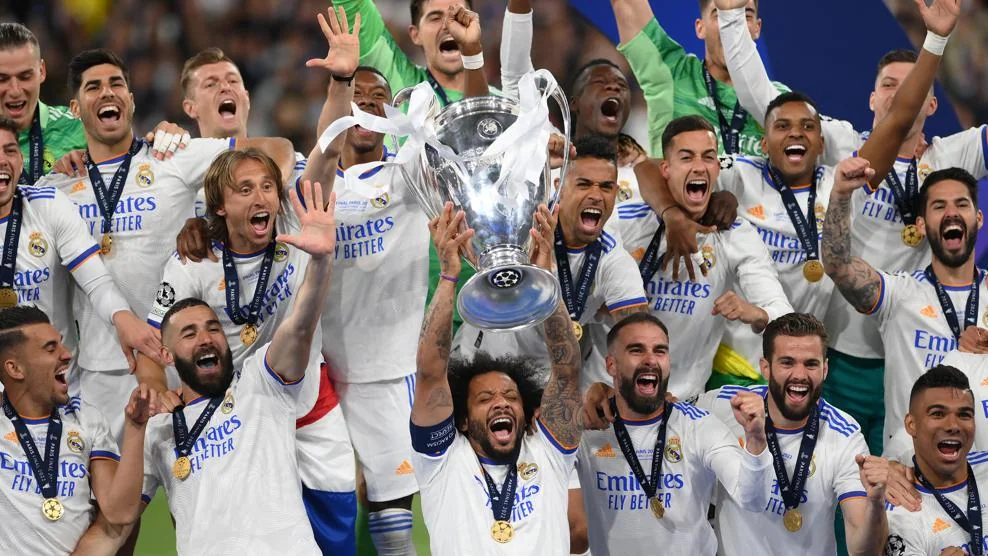
Who won the 2021/22 Champions League?
Real Madrid won the 2021/22 UEFA Champions League, beating Liverpool 1–0 in the final at the Stade de France on 28 May 2022. Vinícius Júnior scored the only goal in the 59th minute, and goalkeeper Thibaut Courtois produced the night's defining performance as Madrid lifted a record-extending 14th European Cup.
| Champion | Real Madrid |
|---|---|
| Runner-up | Liverpool |
| Final score | Liverpool 0–1 Real Madrid |
| Final date and venue | 28 May 2022, Stade de France, Saint-Denis |
| Winning goal | Vinícius Júnior, 59th minute |
| Top scorer | Karim Benzema, 15 goals |
| Final player of the match | Thibaut Courtois |
| Madrid's title number | 14th European Cup |
The final score gives only the last line of an unusually dramatic campaign. Madrid had been behind in every knockout tie from the round of 16 onward. They overturned Paris Saint-Germain, survived Chelsea after extra time, escaped Manchester City with two late Rodrygo goals and then absorbed Liverpool's pressure in Paris. Karim Benzema's 15-goal campaign drove the comebacks, while Courtois was decisive when the trophy itself was on the line.
Why is it called the 2021/22 season rather than just “Champions League 2022”?
The tournament crossed two calendar years. The group stage began in September 2021; the knockout rounds and final were played in 2022. UEFA therefore records the competition as the 2021/22 Champions League. Fans searching “Champions League 2022” usually mean this edition, but using the full season label prevents confusion with the 2022/23 tournament, which began only a few months after Madrid won in Paris.
The distinction also keeps individual moments in the correct campaign. Sheriff's win at the Bernabéu happened in September 2021, even though it belongs to the same title run as the May 2022 final. Benzema's hat-tricks against PSG and Chelsea occurred in spring 2022, but both count toward his 2021/22 total of 15.
For a current-season view, the Champions League results page separates completed matches by competition stage. The historical profile on the Real Madrid team page puts this 14th title into the club's wider European record. The rest of this review rebuilds how the groups and knockout rounds produced that final.
What happened in the 2021/22 Champions League group stage?
The old 32-team, eight-group format produced 16 knockout qualifiers, but the route was not uniformly predictable. Liverpool, Ajax and Bayern won every match. Real Madrid recovered from one of the competition's great upsets to top their group. Barcelona fell into the Europa League, while Lille and Salzburg advanced from a Group G that had no traditional heavyweight.
| Group | Winner | Runner-up | Third place |
|---|---|---|---|
| A | Manchester City | Paris Saint-Germain | RB Leipzig |
| B | Liverpool | Atlético Madrid | Porto |
| C | Ajax | Sporting CP | Borussia Dortmund |
| D | Real Madrid | Inter | Sheriff Tiraspol |
| E | Bayern Munich | Benfica | Barcelona |
| F | Manchester United | Villarreal | Atalanta |
| G | Lille | Salzburg | Sevilla |
| H | Juventus | Chelsea | Zenit |
The table matters because finishing position determined the round-of-16 draw: group winners were seeded and runners-up were unseeded, with clubs from the same group or national association kept apart at that stage. Third-placed teams transferred to the Europa League knockout play-offs. That is why Barcelona and Dortmund did not simply disappear from Europe after December.
How strong was Liverpool's perfect group?
Liverpool's 18 points came from a group containing Atlético Madrid, Porto and AC Milan—not a gentle route assembled after the fact. Jürgen Klopp's side scored 17 goals and conceded six, winning at all three away grounds. They beat Milan 3–2 after trailing at Anfield, scored five in Porto and won 3–2 at Atlético despite losing a two-goal lead. The variety of those victories mattered as much as the perfect record.
They became the first English club to win all six matches in a Champions League group. Ajax and Bayern also finished on 18 points, powered respectively by Sébastien Haller and Robert Lewandowski. Yet perfection did not guarantee the trophy: Ajax went out to Benfica in the round of 16 and Bayern fell to Villarreal in the quarter-finals. Liverpool went furthest of the three, reaching Paris before losing their only match that truly ended the campaign.
Which surprises changed the knockout field?
Sheriff Tiraspol supplied the headline result. The Moldovan debutants led at the Bernabéu through Jasurbek Yakhshiboev, conceded a Karim Benzema penalty, then won 2–1 when Sébastien Thill struck spectacularly in the 90th minute. It was an extraordinary night of compact defending, counterattacking and goalkeeping. It did not, however, carry Sheriff into the last 16. Real Madrid won the group, Inter finished second and Sheriff moved into the Europa League.
Barcelona's third-place finish had greater structural consequences. They scored only two goals in six group matches and lost 3–0 to both Benfica and Bayern. Benfica's home win over Barcelona created the decisive separation, and Bayern's 3–0 victory on the final matchday confirmed that the Catalan club would miss the Champions League knockout rounds for the first time in nearly two decades.
Other groups offered less famous but important outcomes. Lille won Group G after taking one point from their first two matches; Salzburg became the first Austrian club to reach the Champions League round of 16. Juventus edged defending champions Chelsea for first place in Group H. For the current competition, qualification is tracked differently under the league-phase format, so use the current Champions League table rather than applying these eight-group rules today. Historical team context is available for Liverpool, Real Madrid and Barcelona.
How did Real Madrid survive PSG, Chelsea and Manchester City?
Real Madrid's knockout route became famous because they repeatedly lost control of ties without losing belief or decision quality. The romantic shorthand is “Bernabéu magic,” but each comeback had footballing causes: Benzema's pressure and finishing, Modrić's ability to find a pass under stress, impact from Rodrygo and Eduardo Camavinga, and a crowd that amplified every change in momentum. Madrid were also vulnerable for long stretches. The point is not that they planned to fall behind; it is that they retained options after doing so.
What changed against Paris Saint-Germain?
PSG won the first leg 1–0 through Kylian Mbappé's stoppage-time goal. When Mbappé scored again after 39 minutes in Madrid, Paris led 2–0 on aggregate and looked capable of adding more. The tie changed in the 61st minute when Benzema pressed Gianluigi Donnarumma near his own goal. The goalkeeper's delayed pass was turned back by Vinícius, and Benzema finished.
That goal altered the atmosphere and PSG's composure. Modrić broke through midfield and supplied Benzema for the equaliser in the 76th minute. Directly after the restart, PSG failed to clear Vinícius's advance and Benzema guided the loose ball into the corner. His three goals arrived inside 18 minutes, turning a two-goal aggregate deficit into a 3–2 victory. The press created the first; Modrić's progression created the second; alertness to a broken defensive action created the third.
How did Modrić and Rodrygo rescue the Chelsea tie?
Benzema gave Madrid a 3–1 first-leg advantage at Stamford Bridge with another hat-trick, including two outstanding headers. Chelsea then produced one of their best displays under Thomas Tuchel in the return. Goals by Mason Mount, Antonio Rüdiger and Timo Werner put the holders 3–0 ahead on the night and 4–3 up on aggregate after 75 minutes.
The rescue began with a pass that very few players would attempt. Under pressure near the right side of midfield, Modrić used the outside of his right foot to bend the ball behind Chelsea's defence. Substitute Rodrygo volleyed it first time in the 80th minute, levelling the tie and forcing extra time. In the 96th minute, Vinícius crossed and Benzema headed the aggregate winner. Madrid lost the match 3–2 but won the tie 5–4.
That distinction captures the campaign. Chelsea had 29 attempts in the second leg and were the better side for long periods. Madrid did not erase those facts; they survived them. The abolition of the away-goals rule also meant there was no calculation based on where goals were scored. At 4–4 after 180 minutes, the tie simply continued into extra time.
How did two Rodrygo goals erase City's lead?
Manchester City won a wild first leg 4–3, and Riyad Mahrez's 73rd-minute goal at the Bernabéu stretched their aggregate advantage to 5–3. Madrid had not registered a shot on target through 89 minutes. Jack Grealish then came close twice to ending the tie, first denied by Ferland Mendy's goal-line intervention and then by Courtois.
Camavinga's angled pass released Benzema at the back post in the 90th minute, and the striker hooked the ball across for Rodrygo to score. Ninety-one seconds later, Rodrygo met Dani Carvajal's deflected cross with a header to make it 5–5. The substitution had changed Madrid's penalty-area presence: instead of asking Benzema to occupy every central defender alone, Rodrygo repeatedly arrived as a second finisher.
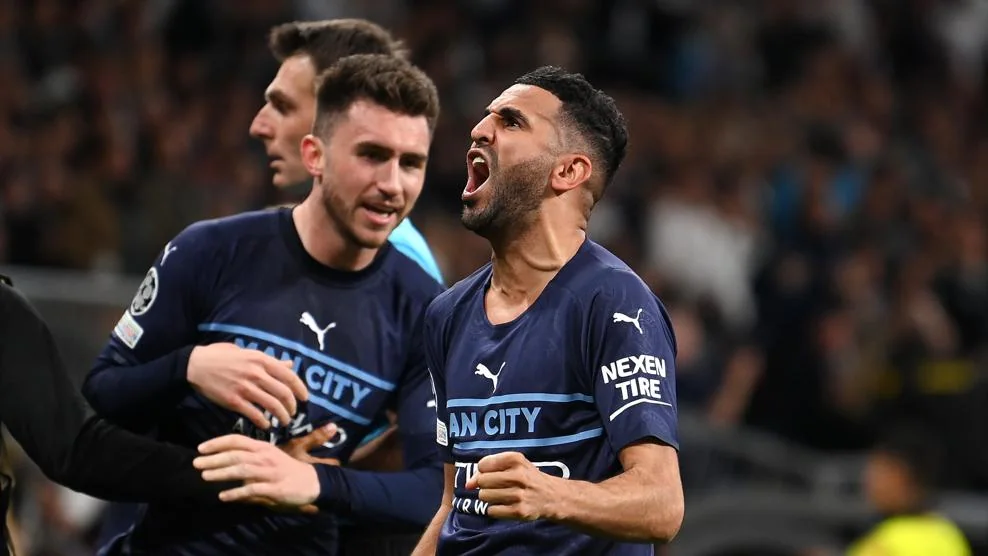
Extra time started with City still processing the reversal. Rúben Dias fouled Benzema, who converted the 95th-minute penalty to complete a 6–5 aggregate win. Madrid's three comebacks were not identical, but their decisive cast kept recurring: Benzema ended moves, Modrić controlled critical passes, Vinícius stretched defences, Rodrygo changed games from the bench and Courtois preserved thin margins. Explore the club's wider record on the Real Madrid team page, or compare the scorelines in the Champions League results archive.
What were all the 2021/22 Champions League knockout results?
The knockout bracket contained 14 two-leg ties and the one-match final. Aggregate scores below combine both legs; “aet” marks ties decided after extra time. The away-goals rule had been removed, so a level aggregate score after the second leg went to extra time regardless of where each goal was scored.
| Round | Tie | Outcome |
|---|---|---|
| Round of 16 | Bayern Munich vs Salzburg | Bayern won 8–2 on aggregate |
| Round of 16 | Manchester City vs Sporting CP | City won 5–0 on aggregate |
| Round of 16 | Benfica vs Ajax | Benfica won 3–2 on aggregate |
| Round of 16 | Chelsea vs Lille | Chelsea won 4–1 on aggregate |
| Round of 16 | Atlético Madrid vs Manchester United | Atlético won 2–1 on aggregate |
| Round of 16 | Villarreal vs Juventus | Villarreal won 4–1 on aggregate |
| Round of 16 | Liverpool vs Inter | Liverpool won 2–1 on aggregate |
| Round of 16 | Real Madrid vs Paris Saint-Germain | Madrid won 3–2 on aggregate |
| Quarter-final | Real Madrid vs Chelsea | Madrid won 5–4 on aggregate, aet |
| Quarter-final | Manchester City vs Atlético Madrid | City won 1–0 on aggregate |
| Quarter-final | Villarreal vs Bayern Munich | Villarreal won 2–1 on aggregate |
| Quarter-final | Liverpool vs Benfica | Liverpool won 6–4 on aggregate |
| Semi-final | Real Madrid vs Manchester City | Madrid won 6–5 on aggregate, aet |
| Semi-final | Liverpool vs Villarreal | Liverpool won 5–2 on aggregate |
| Final | Liverpool vs Real Madrid | Real Madrid won 1–0 |
How did Liverpool reach the final?
Liverpool beat Inter 2–0 in Milan, then lost the return 1–0 at Anfield but progressed 2–1. They defeated Benfica 3–1 away before a 3–3 home draw made the aggregate score 6–4. A 2–0 first-leg win over Villarreal appeared comfortable until the Spanish side scored twice before half-time in the return. Fabinho, Luis Díaz and Sadio Mané answered after the break, turning the match into a 3–2 win and the tie into a 5–2 success.
Why was Villarreal the knockout surprise?
Unai Emery's side arrived from the Europa League and eliminated two former champions. After drawing 1–1 with Juventus at home, Villarreal scored three times late in Turin to win 4–1 on aggregate. Arnaut Danjuma then gave them a 1–0 first-leg lead over Bayern, and substitute Samuel Chukwueze scored in the 88th minute in Munich to secure a 1–1 draw and a 2–1 aggregate upset.
Those results were built on compact distances, patience without the ball and a willingness to counter into the spaces left by favoured opponents. Liverpool eventually exposed the cost of defending so deep, but Villarreal had already reached only the second Champions League semi-final in club history. For individual match scores from the current tournament, use the Champions League results page.
Why did Real Madrid beat Liverpool in the 2022 final?
Madrid won because they defended the most dangerous spaces, received an exceptional goalkeeping performance and converted the one move that fully stretched Liverpool's back line. Liverpool had 54% possession and took 24 shots to Madrid's four. Those numbers describe the pressure accurately. They do not show that every attempt was equally threatening, or that Madrid's plan depended on creating a high volume of chances.
Carlo Ancelotti's side dropped into a shape closer to 4-4-2 when defending, with Federico Valverde recovering on the right and Casemiro sometimes sinking between the centre-backs. The deeper line denied Liverpool easy space behind. Madrid also protected the front-post zone at corners and trusted Courtois to command longer deliveries. The structure bent, particularly in the opening half-hour, but did not collapse.
How did Courtois stop Liverpool's best chances?
Courtois made nine saves, and two defined the final. In the first half, he reacted low to his right to turn Sadio Mané's powerful shot onto the post. In the 83rd minute, Mohamed Salah controlled a long pass and drove toward the far side of goal; Courtois extended his right arm and diverted the shot away. Both were actions that changed the likely score, not routine catches added to a total.
His positioning reduced several other attempts before the save itself. Courtois stayed tall against close-range shots, moved his feet rather than committing early and used his reach when Salah tried to find angles from the right. Liverpool's 24 attempts produced nine saves, a post and multiple blocks or misses. Madrid therefore needed more than defensive organisation. They needed the best goalkeeper on the pitch to perform at the highest level, which is why UEFA named Courtois player of the match.
How did Vinícius find the decisive back-post space?
The winner began well before Valverde's final ball. Modrić escaped Andrew Robertson's pressure near Madrid's right-back area and passed through Liverpool's first line. Dani Carvajal and Casemiro moved the ball on, allowing Valverde to accelerate into the right channel vacated as Robertson recovered.
Valverde drove a low diagonal cross-shot toward the far post. Karim Benzema's movement pulled Ibrahima Konaté toward the front-post zone, while Vinícius stayed behind Trent Alexander-Arnold at the back. The Brazilian arrived unmarked and finished from close range in the 59th minute. The move punished Liverpool's aggressive full-back positioning, but it also required Modrić to beat the first pressure, Valverde to attack decisively and Vinícius to delay his run.
Madrid had threatened the same broad idea earlier by finding Vinícius quickly on the left. Benzema also put the ball into the net shortly before half-time, only for the goal to be ruled out for offside after a lengthy review. The disallowed goal did not count, but it warned Liverpool that Madrid could create danger even while spending long periods without the ball.
What was the season's lasting football legacy?
The 14th title is remembered for comebacks, yet the individual awards show the structure beneath the drama. Benzema was Champions League player of the season and top scorer with 15 goals. Vinícius, who supplied six assists and scored four times, was named young player of the season. Courtois owned the final award. Ancelotti became the first coach to win four European Cups at that point in the competition's history.
Liverpool's defeat was narrow rather than a rejection of their campaign. They won every group match, eliminated three strong opponents and forced the final's outstanding player into nine saves. Madrid's achievement was to survive that pressure after already surviving PSG, Chelsea and City. Their football was not always dominant, but at the decisive moments it was remarkably exact.
Fans revisiting either club can use the Liverpool team page for the Reds' wider European record. For the competition now, upcoming games appear on the Champions League fixtures page, while league-phase positions sit in the current table. The format has changed, but the 2021/22 lesson survives: knockout ties are decided not only by who controls more play, but by who protects and converts the moments that matter most.
Sign in with Google to join the discussion.